What a Data Center Near Stickney Would Mean for Cicero and Berwyn, and How to Prepare
After the bankruptcy sale of the Hawthorne Race Course, neighbors worry a data center could replace it. Learn what Stickney's moratorium means for the near term future of the site and what residents can do.
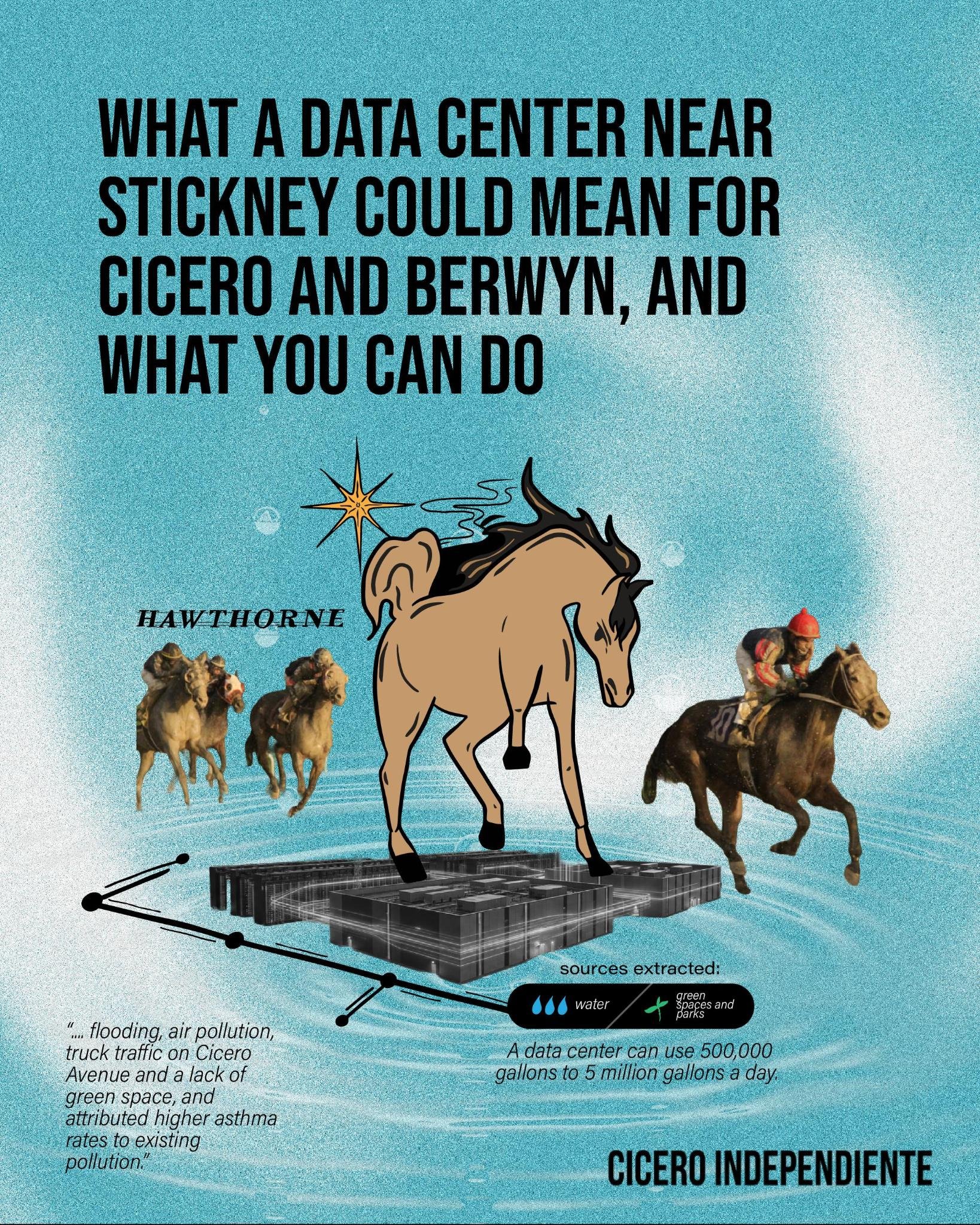
JournalARTist Illustration by Luz Canela
By Luis Caro
Additional reporting by Irene Romulo
The lack of transparency surrounding the bankruptcy of the Hawthorne Race Course has left residents of Stickney, and neighbouring towns like Cicero and Berwyn, worried that a data center will be built on the site.
Rumors started to circulate online after the buyer’s name became public. Reporting from The Real Deal linked Digital Realty as the buyer, a company that specializes in data centers.
On July 28, the Town of Cicero preemptively passed a resolution opposing the construction of data centers at both the Hawthorne race track and the MWRD plant.
And on August 20 2026, Stickney township unanimously approved a 6-month moratorium, preventing the zoning relief, licensing, development and permit approval for data centers within the village of Stickney.
“I want to be clear,” wrote Mayor Mitch Milenkovic in a statement shared on Facebook on Aug. 20. “If a data center project for Hawthorne Race Course lands before the Board of Trustees, I will vote no.”
Residents have asked how they can get involved. So, here’s what we know:
What’s the status of the moratorium?
The moratorium will end in February of 2027 and can be extended after the 6-month deadline, according to the language of the approved ordinance.
Stickney has not currently scheduled any public hearings or research committees to study data centers. In response to Cicero Independiente’s questions, the village attorney Jessica Fese said Stickney’s priority is to address immediate safety concerns such as ensuring that the vacant site is boarded up and secured. If any hearings are scheduled they will be posted on the Stickney website here.
City Clerk Candace Cetrangolo also confirmed, via Freedom of Information Act (FOIA) request, that no zoning meetings are scheduled for 2026 so far.
At a meeting on Sept. 1, Fese shared that the new owners have to either bring structures at the site up to code or demolish them. According to the lawyer, the company is choosing to demolish and applied for an extension to the demolishing deadline. They now have 12 months, with a possible extension up to 18 months, to demolish structures on the site.
As part of the sale, Hawthorne’s new owners will also have to pay all past due back taxes, which include six installments that Hawthorne missed, according to Fese.
Residents at the meetings expressed needing something to be built that will generate taxes for the township, and some argue that a data center would do that. Others, however, expressed concerns.
Why would a data center not be wanted? What sort of effects could they have?
Hannah Flath, director of communications at the Illinois Environmental Council, boiled it down to three major issues: Water, energy, and community impacts.
“You’ve probably heard data centers use water to cool the servers that are housed at their facilities…and it requires quite a lot of water, upwards of 5 million gallons a day, and we are cognizant of the fact that in central Illinois, for example, we are already facing droughts,” said Flath. “While we do have a lot of water resources in the state, obviously people point to Lake Michigan and our various aquifers and lakes and rivers, it still is a finite resource.”
Of course, the size of the data center does matter. With a small center using 500,000 gallons of water daily, and a large center using up to 5 million gallons per day, about 1.8 billion annually.
An equivalent to a town of 10,000 to 50,000 people.
Stickney only has a population of roughly 7,000 - while Cicero has about 82,000.
Imagine placing a second, or even third, Stickney right next to Cicero, without improving any water distribution or considering the strain on water sources.
It's a similar story with energy use, Flath further detailed.
“We're talking truly astronomical amount of energy consumption. The Joliet data center that was approved in March of this year is 1.8 gigawatts – enough to power half of the city of Chicago,” said Flath. “And at a time when we're already in an energy affordability crisis, we are worried about our grid reliability.”
We’ve already seen U.S. electricity bills rise due to strain caused by the mere existence of data centers, and studies project an 8% rise by 2030.
PJM, a regional transmission organization covering land from Illinois to North Carolina, saw capacity prices rise from $28.92 /megawatt-day in most zones for 2024 to $329.17/megawatt-day for 2026 and 2027.
As Pew Research notes, that’s an extra $16 a month on the average Ohio bill, or an extra $18 if you’re in western Maryland. Although Illinois isn’t mentioned, PJM Interconnection does supply part of Illinois.
And we can’t forget about its many community impacts. The constant noise, the false promise of potential jobs, not to mention the pollution, according to Lucy Contreras, state program director for GreenLatinos.
“What we often see with the work that we do is that industrial development can often be one-sided,” said Contreras.
“Corporations come into a community and a lot of extraction that happens with not a lot of benefits that trickle down to the local community... Data centers are disproportionately located in low-income communities and communities of color. Oftentimes, the communities that they are being cited in are already environmental justice communities, which means that they already bear a lot of environmental burdens.”
Contreras points to Cicero as a clear example of this pattern. Having lived in the community most of her life, she’s familiar with the environmental challenges it already faces. From flooding to air pollution, from trucks passing through Cicero Avenue to lack of green space.
Those burdens are already showing up in residents’ health, she said, pointing to increased asthma rates in Cicero that she attributes to the pollution the community is already exposed to, even before a data center is added to the mix.
Cicero Town Board President Larry Dominick has already said he doesn’t want to “ruin Cicero” after a 6-0 vote on a resolution to oppose “any proposal, consideration or approval of a data center at the property formerly known as the Hawthorne Race Course.”
So what change is under way?
Cicero Independiente talked to Jen Walling, CEO of the Illinois Environmental Council, to ask for recommendations. She pointed to Aurora’s current legislation as something communities can advocate for, and it started just like Stickney’s did, with a moratorium.
“Aurora enacted a moratorium, and it expired I think in March or April of this year, but we worked with Aurora to do something similar to the POWER Act that we have at the legislature, which is Protecting Our Water Energy, and Ratepayers Act,” said Walling.
She mentions that the POWER Act has multiple groups backing at the state level. Although the specifics are not quite set in stone, its focus is the same as Aurora’s, which features 3 main components.
The energy piece prioritizes companies that bring their own new clean energy source
The water piece sets strict permitting requirements, including closed-loop, water-efficient systems and disclosure of where water is sourced, where it’s discharged and how much is used.
The community piece requires transparency and community benefit agreements
“We see Aurora's ordinance as really a gold standard of ordinances that have passed. And we're hoping that other communities follow suit in really strictly regulating any facilities that come in, whether they do it through ordinance or whether they require that as the facility comes in the door,” said Walling. “I think Aurora's ordinance is exactly parallel to what we are doing at the state level”
Again, the POWER Act is their stab at state level action, and if it passes there may be no need for dozens of counties to all independently pass moratoriums and legislature - and no spots for data centers to sink their teeth into Illinois.
State Sen. Ram Villivalam is sponsoring the bill in the Senate, and state Rep. Robyn Gabel is the lead sponsor in the House so support can be voiced here.
And legislators near Cicero, Stickney and Berwyn
Javier L. Cervantes, Senator - senator.jcervantes@gmail.com
Elizabeth Hernandez, Representative - office@repehernandez.com
Mike Porfirio, Senator - http://www.senatorporfirio.com/contact-us
Abdelnasser Rashid, Representative - office@reprashid.com
Celina Villanueva, Senator - https://www.senatorvillanueva.com/contact-us
Edgar Gonzalez Jr, Representative - office@repedgargonzalez.com
Though of course, you can always find your Illinois legislators here.
JB Pritzker recently voiced support of the POWER Act, and even signed an executive order in which established a board to regulate AI in Illinois.
So, what can we do?
Contreras recommends communities become familiar with the permits and zoning processes, as there may be particulars to the area, but it doesn’t stop there.
“Making sure that you show up and give public comments at your town meetings, making sure that you're communicating directly with your elected officials, you know, at every level from the local town level to the state level, how you feel about data centers,” said Contreras.” Elected officials do respond to public pressure.”
The Village of Stickney Board of Trustees meets on the first and third Tuesday of every month, unless that Tuesday is a federal holiday, in which case it is held on Wednesday. Anyone can make a public statement at these meetings. Stickney requires that people sign up to speak before the meeting starts.
If you can’t attend, you can email the board members using these emails:
Brian Klouda - bklouda@villageofstickney.com
Debra Johnson - djohnson@villageofstickney.com
Jim Hrejsa - jhrejsa@villageofstickney.com
Lea Torres - ltorres@villageofstickney.com
Ron Smith - rsmith@villageofstickney.com
Tim Kapolnek - tkapolnek@villageofstickney.com
Luis Caro is a freelance writer and multimedia journalist based in Chicago, Ill with a knack for investigative work and local news. He graduated from DePaul majoring in journalism and minoring in psychology and documentary production.



Want to read more stories like this? Consider donating to support our work. Your money goes directly towards paying journalists of color to report on local news.