Taking The Long Way
With increased ICE presence in airports and along other routes, traveling requires extra planning.
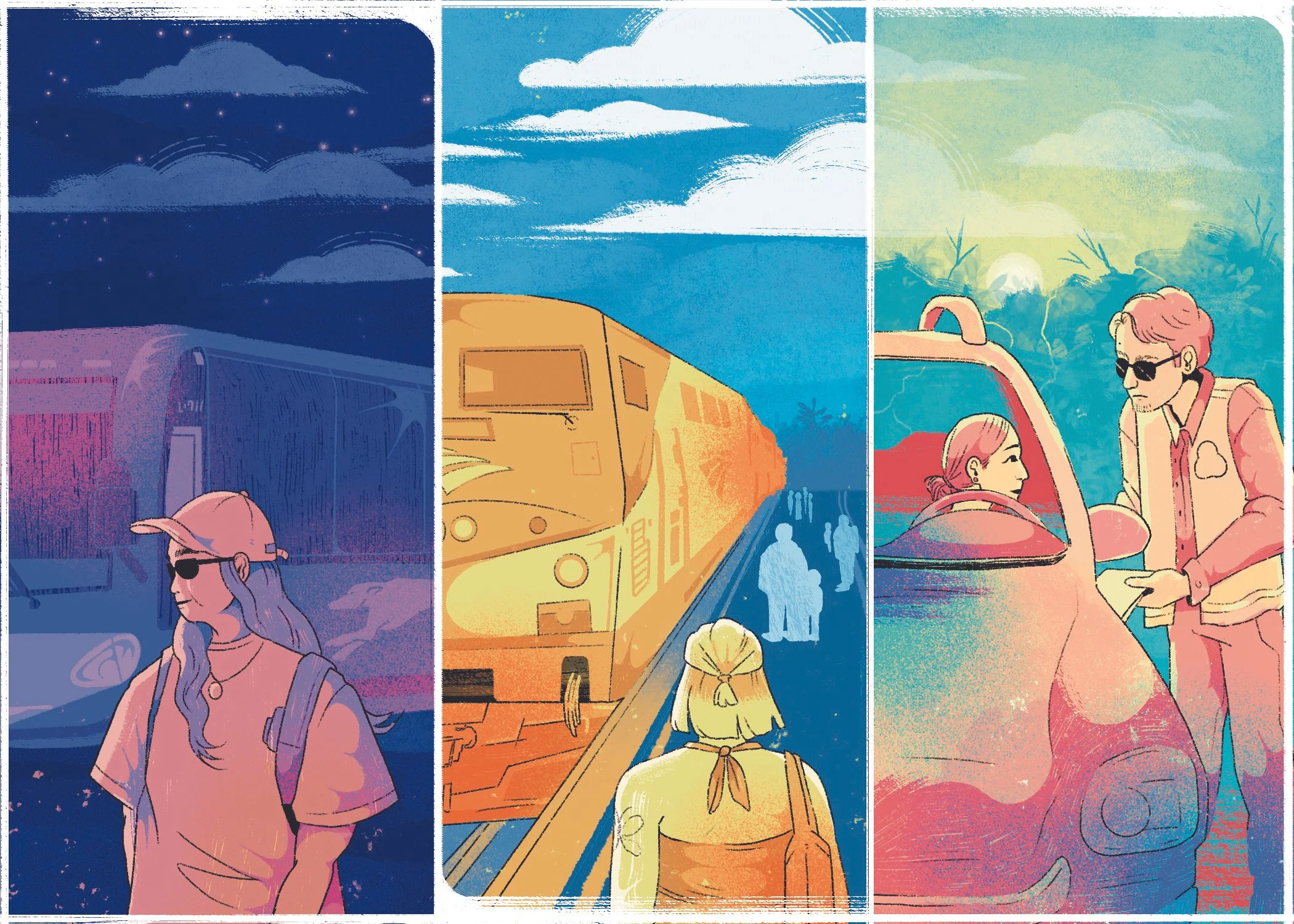
Illustration by Shane Tolentino
By Noma Lee
This story was coproduced with The Chicago Reader. This version was translated by Jacqueline Serrato.
Traveling is a fulfilling activity that everyone should get a chance to enjoy.
With that in mind, my partner and I started planning a trip to San Francisco a few months ago. We were going to go wine tasting in Napa, see the redwoods, and cross the Golden Gate Bridge. Almost everything was planned out until, in late March, immigration agents started showing up at some of the country’s major airports.
For many immigrants, this made the idea of navigating an airport feel even harder than it already was. Starting May 7, 2025, the REAL ID Act went into effect at TSA checkpoints nationwide, meaning travelers need a REAL ID–compliant license, passport, or other federally approved document to board a domestic flight.
Those without a compliant ID can pay a $45 fee through TSA ConfirmID—but the process can take up to 30 minutes and doesn't guarantee boarding. For undocumented immigrants, who are not eligible to obtain a REAL ID, this added yet another reason to think twice about flying.
I eventually decided it wasn’t a good idea to play the "who gets detained" lottery at the airport, and our flight to the Bay Area became a train journey to New Orleans.
For those who have decided to avoid airports, the most common transportation options are on the ground: bus, train, or car. Each offers something different in terms of cost, time, and the very nature of traveling across the country.
Traveling by land can alleviate some of the stress many immigrants feel in airports, but none of these options is entirely free from encountering authorities.
On the road, there are checkpoints and inspection stations operated by U.S. Customs and Border Protection (CBP). Some are permanent, located on key highways in the south and along the west coast. However, there are also tactical checkpoints—temporary and unannounced—that can appear on any route within an area the federal government designates as the "100-mile border zone." This encompasses any location within one hundred miles (160 kilometers) of the Canada and Mexico borders and the coasts.
Many people are unaware of just how much territory this zone covers: Chicago, New York, Los Angeles, Houston, and Miami all fall within this range. According to the ACLU, that means two-thirds of the U.S. population lives within it.
On buses and trains, the dynamic differs, yet the risk remains: These routes may not have a regular Immigration and Customs Enforcement (ICE) or CBP presence—but that does not mean an encounter cannot happen, especially in regions within that zone. It’s best to be informed about the immigration enforcement policies of each city and state before you travel, according to Immigrants Rising, a nonprofit that provides resources, legal support, and career guidance to undocumented young people.
The presence of immigration authorities on land routes is nothing new. In fact, in 2020, Greyhound announced that immigration enforcement agencies needed a warrant to board its buses. This came after the ACLU documented systematic cases of warrantless searches on Greyhound routes in several states.
This policy remains in effect and is currently posted on their website: Greyhound does not consent to Department of Homeland Security, CBP, or ICE agents boarding its buses without a written warrant. Furthermore, any verbal request for access must be documented. Greyhound, Amtrak, and FlixBus did not respond to requests for comment.
While these scenarios do not happen on every trip or route, they are factors many immigrant families weigh when deciding how to travel within the United States. Here are some of the things to keep in mind, from comfort to practicality, when planning your trip.
Bus: the most affordable option
Companies like Greyhound and FlixBus connect Illinois with cities across the country—and even offer routes to Canada and Mexico—making bus travel one of the most accessible options for ground transportation. Fares vary based on distance, season, and how far in advance you book.
One-way midwest regional trips within the midwest can range from $15 to $100; routes to the south or the east coast can range from $120 to $350; longer trips to the west coast and international routes can range from $150 to $400.
While this option tends to feel less intimidating than an airport in terms of security checks, it also involves long periods of sitting and total reliance on specific routes, layovers, and terminals.
Train: more space, more comfort
Although it resembles the bus in some ways, the train offers a very different experience. Amtrak routes connect Illinois with cities in the midwest, east coast, south, and parts of the west coast.
Some long-distance routes can span several days, cross multiple states, and reach cities in Canada.
Tickets tend to be more expensive than bus fares, especially for long trips or when booked on short notice. One-way midwest regional trips in the midwest can cost between $40 and $240; routes to the south or east coast typically range from $150 to $350; long-distance trips to the west coast can exceed $400. Private rooms or sleeper cars can range from $900 to $1,700, depending on the route and season.
The cost is reflected in the amenities: The seats are more spacious, and some cabins include convertible beds as well as food and beverage service. On long routes, Amtrak offers showers in certain private compartments.
Car: route flexibility
For many people, traveling by car offers something that buses and trains cannot: route flexibility. Not being tied to schedules, stations, or fixed routes allows you to decide when to leave, where to stop, and how much time to spend on the road. It is an option that can be more economical for families or large groups who want to split the costs.
However, that flexibility also changes the nature of the journey. On long trips, driving involves spending several consecutive hours on the move, planning rest stops, and calculating additional expenses such as gas, tolls, food, and lodging. Regarding costs, it is important to note that regular gasoline prices vary by region and state, and are on the rise.
Hotels and motels also make up a significant part of the budget, and prices vary considerably depending on the city, the season, and how far in advance you book. Sites like Booking.com or Expedia can give you a real-time estimate for your specific route.
For some, driving offers a greater sense of privacy and control. However, long hours behind the wheel, lack of sleep, and the need for constant attention make the road trip a completely different experience—and that, too, is part of budgeting.
Identification: what you can and cannot be asked for
It is important to note that the transportation companies mentioned in this article do not require immigration documents to purchase tickets. However, if you are traveling outside city limits, you do need a valid photo ID—either to board or to confirm that your name matches the one on the ticket.
For those without legal immigration status, other forms of identification are valid in these situations, such as a consular ID card (matrícula consular), a current foreign passport, or a state driver's license—in Illinois, for example, it is possible to obtain one without a Social Security number or legal immigration status. It's important to know that if an immigration agent boards a train or bus, passengers have rights worth being aware of.
So, was it worth it?
Yes, my trip ended up being a revelation. New Orleans was worth all 20 hours on the train. Honestly, I had completely underestimated it but left completely won over, already wanting to go back. The food was out of this world, art and music wrap around every corner, and the people are incredible.
If I learned anything, it’s that long-distance train travel is a world of its own; it pays to be prepared for those moments when your body simply can’t stand the seat for another minute, or when you’re struggling not to fall over in a bathroom that’s constantly in motion.
Before making any decision, it’s worth taking a moment to reflect and crunch the real cost—not just the ticket price, but the total travel time, what it entails to spend hours on the road or in a terminal, what the potential risks are, and how prepared you are for that. Each option depends on where you’re going, who you’re traveling with, and how much time you have. What works for a regional trip doesn’t necessarily work for crossing several states.
This article isn’t meant to tell you how to travel, but rather to offer options so you can make informed decisions. Ultimately, the best trip is the one you can take with peace of mind.
Find a copy of this in print at a nearby Chicago Reader distribution location here or view the pdf version on page 12 here.
*Noma Lee is a reporter with Cicero Independiente covering our multigenerational, immigrant community in Cicero and Berwyn. She is a Venezuelan journalist whose work explores migration, culture, and community storytelling, with a focus on immigrant communities in the Midwest.
*Noma Lee is a pseudonym used for the protection and safety of our reporter.



Want to read more stories like this? Consider donating to support our work. Your money goes directly towards paying journalists of color to report on local news.
SUBSCRIBE
Bringing you news from the 60804
We respect your privacy and will only use your information to send you our latest posts.