FIRME: The Program Training Latinx Parents to Advocate for Children with Disabilities
The results are in, new research suggests that culturally relevant training advocacy programs like FIRME leave families empowered to advocate for children with disabilities and with a greater knowledge of special education.

Illustration by Robin Carnilius
By Efrain Soriano
For years, Ericka Saucedo sat quietly through her son's Individualized Education Plan (IEP) meetings at Columbus East Elementary School. When the principal asked if she had questions or goals for Luis, she stayed silent.
An IEP meeting is meant to be a place where parents or guardians play an equal and active role in the decisions made about their child’s education.
“Before, when the principal asked if I had any questions or goals for my son, I didn't say anything because I felt like they wouldn't listen to me or that I didn't have the right,” said Saucedo.
That changed after Saucedo participated in the Families Included in Receiving Better Special Education (FIRME) program in 2023.
“I've always been going to IEP meetings, but now after being in the FIRME program, I know I have the right to ask many questions,” she said.
Earlier this year, Saucedo successfully advocated for her fourth-grader to see a social worker and occupational therapist after they were removed from his plan. A win that came only after "insisting and insisting," she said. "And my child has made a lot of progress since then."
Saucedo's transformation reflects exactly what Kristina Rios, a researcher and professor at California State University, Fresno, hoped to achieve when she created FIRME.
“A lot of families, especially families from minority backgrounds, really put trust and faith into the educational system. Which is great, as we should, but then they feel like they're not the experts of their own child,” said Rios.
According to Rios, this is especially true amongst immigrant and first-generation Latinx families who are not familiar with all the ins and outs of the education system. Interpreters who do not accurately communicate or power imbalances within the IEP team can leave parents feeling disempowered to participate in their child’s education.
As was the case with Belen Rodriguez and her son Michael last year in our investigation: School District 99 Parents Concerned About Special Education Gaps, Long-Time Teacher Resigns in Solidarity. These feelings of disempowerment are exactly why Rios began the FIRME program as part of her research at the University of Illinois at Chicago in 2021.
The program consists of a series of advocacy training sessions for Latinx and Hispanic parents of a child with a disability or an IEP, all provided in Spanish. The program offered training ranging from informative breakdowns of the Individuals with Disabilities Education Act (IDEA) law to mock IEP meetings to practice non-adversarial advocacy strategies.
After the first run of the FIRME program in Chicagoland in the summer of 2021, Rios says the response and feedback was overwhelmingly positive. The main feedback she received from parents who participated in the program was that they wished the three-hour sessions on Saturday morning could be even longer.
“Parents are just hungry for knowledge, right? They want to know everything and listen to everything. And of course, you can't do that in four sessions, right? So I'm looking into expanding the program,” said Rios.
The findings conclude that participants in FIRME show a significant increase in special education knowledge, family empowerment and advocacy.
Saucedo said she greatly appreciated the inclusivity of the program and its focus on Intellectual and Developmental Disabilities (IDD). Inclusivity and individualization are core tenants of IEPs. Although this individualized nature also makes it difficult to create a general training that prepares every parent to advocate for their child, according to Rios. “I do provide them with different samples of IEPs, but I don't think there's anything like having your own child’s IEP and reviewing that,” she said.
Rios said she hopes to continue not only expanding the program, but also the research and academic literature surrounding the effectiveness of advocacy training programs for Latinx families. “If it’s not in the literature, then it doesn’t exist,” she said. “At the start of all this when I was researching what parent advocacy programs are out there. I found that nationwide there were 12 and only two of them were conducted in Spanish.”
The FIRME program has run a total of four times now since 2021 across Illinois, California and New York, and is set to return to Chicago in winter 2026 for the first time since 2023. 2026 will mark the first time that FIRME is offered in both California and Illinois simultaneously. Currently the biggest hurdle in consistently running a program like FIRME is funding, according to Rios.
“Federal and state funding for programs like this tends to be highly competitive. Additionally, with the current government climate, it has become increasingly difficult to secure funding that specifically targets families from minority backgrounds. Many grant opportunities have shifted their priorities, so finding sustained or targeted support for culturally and linguistically responsive initiatives can be challenging,” said Rios.
Saucedo is feeling less stress about her child’s education and has even noticed an improvement in her relationship with her son. A change she attributes in part to the support of other parents who participated in FIRME alongside her. Saucedo has already enrolled to participate once again in FIRME’s 2026 run in Chicagoland, hoping to learn more about preparing for transitions as her son enters middle school next year.
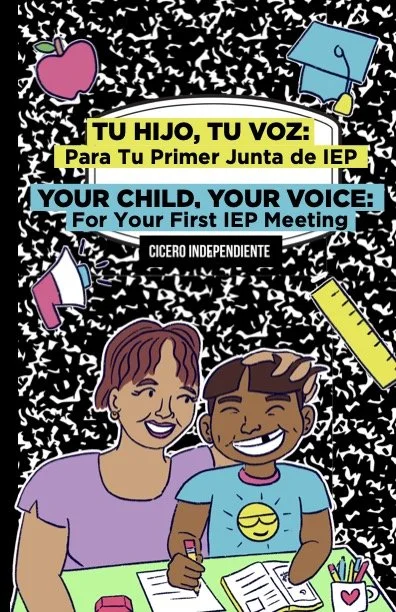
Check out our IEP resource guide created to help parents feel empowered to seek justice and receive the services their children are entitled to and informed by the best practices according to Kristina Rios who led the FIRME program.
Zine illustrations and layout design by Robin Carnilius.
Efrain Soriano is the Youth and Schools Reporter for Cicero Independiente and a freelance photographer in the local area.



Want to read more stories like this? Consider donating to support our work. Your money goes directly towards paying journalists of color to report on local news.
SUBSCRIBE
Bringing you news from the 60804